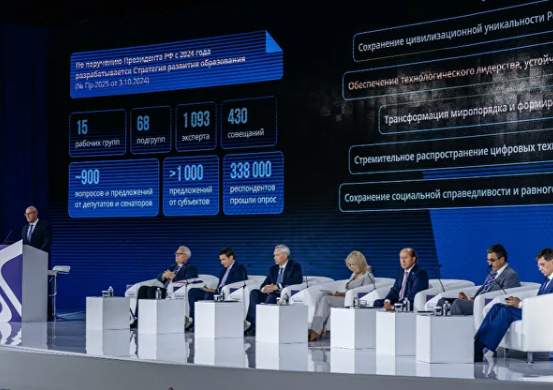
Starting in 2024, Russia began implementing national projects - large-scale programs aimed at improving the quality of life of citizens and strengthening the country's position. They were launched in accordance with the decree of President Vladimir Putin "On the national development goals of the Russian Federation for the period up to 2030 and for the future until 2036" dated May 7, 2024.
"Youth and Children": a large-scale state program to educate the patriotic generation and support young people 14-35 years old includes nine federal projects in the areas of education, civic engagement, career and volunteering. The goal is to involve at least 75% of youth in self-realization projects by 2030. In the first year, the program reached 52 million people - a record for scale and audience. In 2026, it is planned to support 1.8 million students (grants and other measures) with total funding of 546.9 billion rubles, of which 1.4 billion rubles - for grant support. Key areas: infrastructure development (campuses, schools) and vocational guidance.
"Personnel": the program is aimed at retraining citizens and their involvement in employment, taking into account the needs of the economy. In 2026, 15 billion rubles will be allocated for it - the funds will go to free training in 186 popular professions, including agronomists, engineers, nurses and IT specialists.
"Long and active life": the national project is aimed at increasing life expectancy in the Russian Federation to 78 years by 2030 and to 81 years by 2036. At the beginning of 2026, he united 11 federal projects with funding over 2 trillion rubles and was the leader in spending among national projects. Key areas: development of primary health care (384 facilities were created, over 1,000 buildings were repaired); digitalization of healthcare; fight against cancer and cardiovascular diseases; development of geriatric care and medical rehabilitation.
"New technologies for saving health": launched in 2025 to replace the national project "Healthcare," in 2026 it is actively implemented to ensure technological sovereignty in medicine. The main directions: the development of medical science, the creation of drugs and medical devices, the introduction of biomedical and cognitive technologies, ensuring active longevity.
"Infrastructure for Life": The project is aimed at the development of transport, housing and communal services with financing of about 1.36 trillion rubles. Key goals: to bring over 19 thousand km of regional and local roads to a standard state, update housing and communal services facilities and improve the quality of the urban environment.
"Ecological well-being": the national project, which replaced "Ecology," is aimed at comprehensively improving the ecology and health of citizens. It includes five areas: infrastructure for processing and disposal, rehabilitation of water bodies (including the Volga), emissions reduction (continuation of the Clean Air project), conservation of forests and species, as well as monitoring and innovation. In 2026, it is planned to launch new facilities for the management of municipal solid waste (MSW) with a total capacity of 7 million tons. By 2030, the goal of the project is to reduce the volume of waste disposal by up to 50%.
"Efficient and competitive economy": stimulates sustainable economic growth through competition, entrepreneurship (including high-tech) and private initiative; at the beginning of 2026, the revenue of small technology companies (STC) amounted to 1.2 trillion rubles, and real income per employee of small and medium-sized enterprises (SME) increased by 117.4%.
"Data Economics and the Digital Transformation of the State". The project-replacement of the "Digital Economy" accelerates the digital transformation of power, economy and social sphere. It is planned to expand the Top IT and Top AI programs, involve IT companies in training personnel, accept 180 thousand students on the budget in IT areas in 2026 and conduct the Internet in more than 1.5 thousand settlements with a population of 100 to 1 thousand people.
"New Materials and Chemistry". The goal is to create infrastructure for systemic development and technological independence, to form new markets and technological leadership in chemistry and biotechnology, new materials and rare earth metals. According to the Ministry of Finance of Russia, as of January 1, 2026, the national project mastered 94.22% of the allocated funds (the worst indicator for spending). For this year, the Ministry of Industry and Trade predicts an increase in the production of chemical products by 1.5-2.2% with an emphasis on mineral fertilizers, polymers and plastics, paints and varnishes, and low- and medium-tonnage chemistry; in the latter it is planned to create 2.7 thousand jobs.
"Production and automation facilities". The goal of the national project is to provide technological leadership in the production of high-tech machines and to increase industrial robotization. According to the Ministry of Finance, as of February 1, 2026, the use of the budget was zero, but by the end of the first quarter, the use was 5.3% (1.8 billion rubles), which is one of the lowest rates among national projects. State support measures are provided, for example, the maximum amount of support can reach 2 billion rubles with a project implementation period of up to five years, grant programs for small enterprises are provided, etc.
"Technological provision of food security": as of March 2026, the implementation of project costs amounted to 14.8% of planned appointments. In 2026, 19.8 billion rubles were allocated for the project. - 36% more than in 2025 (14.5 billion). It is planned to open more than 1,300 agricultural classes, a new agrobiotechnopark "Cluster Vavilov" with at least 30 scientific groups has opened in the Republic of Adygea.
"New Nuclear and Energy Technologies." The goal of the project is to provide global leadership in nuclear technologies and technological sovereignty in new energy solutions. For 2026, funding amounts to 41.8 billion rubles. Small nuclear power programs have been launched and work is underway on the BREST-OD-300 reactor installation at the site of the Siberian Chemical Plant in Seversk. Part of the funds comes from extra-budgetary resources, mainly from ROSATOM.
"Technological support of the bioeconomy". The key task of the national project is to unite the efforts of the state, science and business to create competitive enterprises, including through the modernization of existing industries. The project includes three federal areas: "Organization of production and promotion of sales of bioeconomy products", "Scientific and technological support for the development of bioeconomy", "Analytical, methodological and personnel support of the bioeconomy". In 2026, 754.1 million rubles are planned for the implementation of the national project.
"Youth and Children": a large-scale state program to educate the patriotic generation and support young people 14-35 years old includes nine federal projects in the areas of education, civic engagement, career and volunteering. The goal is to involve at least 75% of youth in self-realization projects by 2030. In the first year, the program reached 52 million people - a record for scale and audience. In 2026, it is planned to support 1.8 million students (grants and other measures) with total funding of 546.9 billion rubles, of which 1.4 billion rubles - for grant support. Key areas: infrastructure development (campuses, schools) and vocational guidance.
"Personnel": the program is aimed at retraining citizens and their involvement in employment, taking into account the needs of the economy. In 2026, 15 billion rubles will be allocated for it - the funds will go to free training in 186 popular professions, including agronomists, engineers, nurses and IT specialists.
"Long and active life": the national project is aimed at increasing life expectancy in the Russian Federation to 78 years by 2030 and to 81 years by 2036. At the beginning of 2026, he united 11 federal projects with funding over 2 trillion rubles and was the leader in spending among national projects. Key areas: development of primary health care (384 facilities were created, over 1,000 buildings were repaired); digitalization of healthcare; fight against cancer and cardiovascular diseases; development of geriatric care and medical rehabilitation.
"New technologies for saving health": launched in 2025 to replace the national project "Healthcare," in 2026 it is actively implemented to ensure technological sovereignty in medicine. The main directions: the development of medical science, the creation of drugs and medical devices, the introduction of biomedical and cognitive technologies, ensuring active longevity.
"Infrastructure for Life": The project is aimed at the development of transport, housing and communal services with financing of about 1.36 trillion rubles. Key goals: to bring over 19 thousand km of regional and local roads to a standard state, update housing and communal services facilities and improve the quality of the urban environment.
"Ecological well-being": the national project, which replaced "Ecology," is aimed at comprehensively improving the ecology and health of citizens. It includes five areas: infrastructure for processing and disposal, rehabilitation of water bodies (including the Volga), emissions reduction (continuation of the Clean Air project), conservation of forests and species, as well as monitoring and innovation. In 2026, it is planned to launch new facilities for the management of municipal solid waste (MSW) with a total capacity of 7 million tons. By 2030, the goal of the project is to reduce the volume of waste disposal by up to 50%.
"Efficient and competitive economy": stimulates sustainable economic growth through competition, entrepreneurship (including high-tech) and private initiative; at the beginning of 2026, the revenue of small technology companies (STC) amounted to 1.2 trillion rubles, and real income per employee of small and medium-sized enterprises (SME) increased by 117.4%.
"Data Economics and the Digital Transformation of the State". The project-replacement of the "Digital Economy" accelerates the digital transformation of power, economy and social sphere. It is planned to expand the Top IT and Top AI programs, involve IT companies in training personnel, accept 180 thousand students on the budget in IT areas in 2026 and conduct the Internet in more than 1.5 thousand settlements with a population of 100 to 1 thousand people.
"New Materials and Chemistry". The goal is to create infrastructure for systemic development and technological independence, to form new markets and technological leadership in chemistry and biotechnology, new materials and rare earth metals. According to the Ministry of Finance of Russia, as of January 1, 2026, the national project mastered 94.22% of the allocated funds (the worst indicator for spending). For this year, the Ministry of Industry and Trade predicts an increase in the production of chemical products by 1.5-2.2% with an emphasis on mineral fertilizers, polymers and plastics, paints and varnishes, and low- and medium-tonnage chemistry; in the latter it is planned to create 2.7 thousand jobs.
"Production and automation facilities". The goal of the national project is to provide technological leadership in the production of high-tech machines and to increase industrial robotization. According to the Ministry of Finance, as of February 1, 2026, the use of the budget was zero, but by the end of the first quarter, the use was 5.3% (1.8 billion rubles), which is one of the lowest rates among national projects. State support measures are provided, for example, the maximum amount of support can reach 2 billion rubles with a project implementation period of up to five years, grant programs for small enterprises are provided, etc.
"Technological provision of food security": as of March 2026, the implementation of project costs amounted to 14.8% of planned appointments. In 2026, 19.8 billion rubles were allocated for the project. - 36% more than in 2025 (14.5 billion). It is planned to open more than 1,300 agricultural classes, a new agrobiotechnopark "Cluster Vavilov" with at least 30 scientific groups has opened in the Republic of Adygea.
"New Nuclear and Energy Technologies." The goal of the project is to provide global leadership in nuclear technologies and technological sovereignty in new energy solutions. For 2026, funding amounts to 41.8 billion rubles. Small nuclear power programs have been launched and work is underway on the BREST-OD-300 reactor installation at the site of the Siberian Chemical Plant in Seversk. Part of the funds comes from extra-budgetary resources, mainly from ROSATOM.
"Technological support of the bioeconomy". The key task of the national project is to unite the efforts of the state, science and business to create competitive enterprises, including through the modernization of existing industries. The project includes three federal areas: "Organization of production and promotion of sales of bioeconomy products", "Scientific and technological support for the development of bioeconomy", "Analytical, methodological and personnel support of the bioeconomy". In 2026, 754.1 million rubles are planned for the implementation of the national project.